From Milk to 1,800 Cheeses: How Biology Does the Work
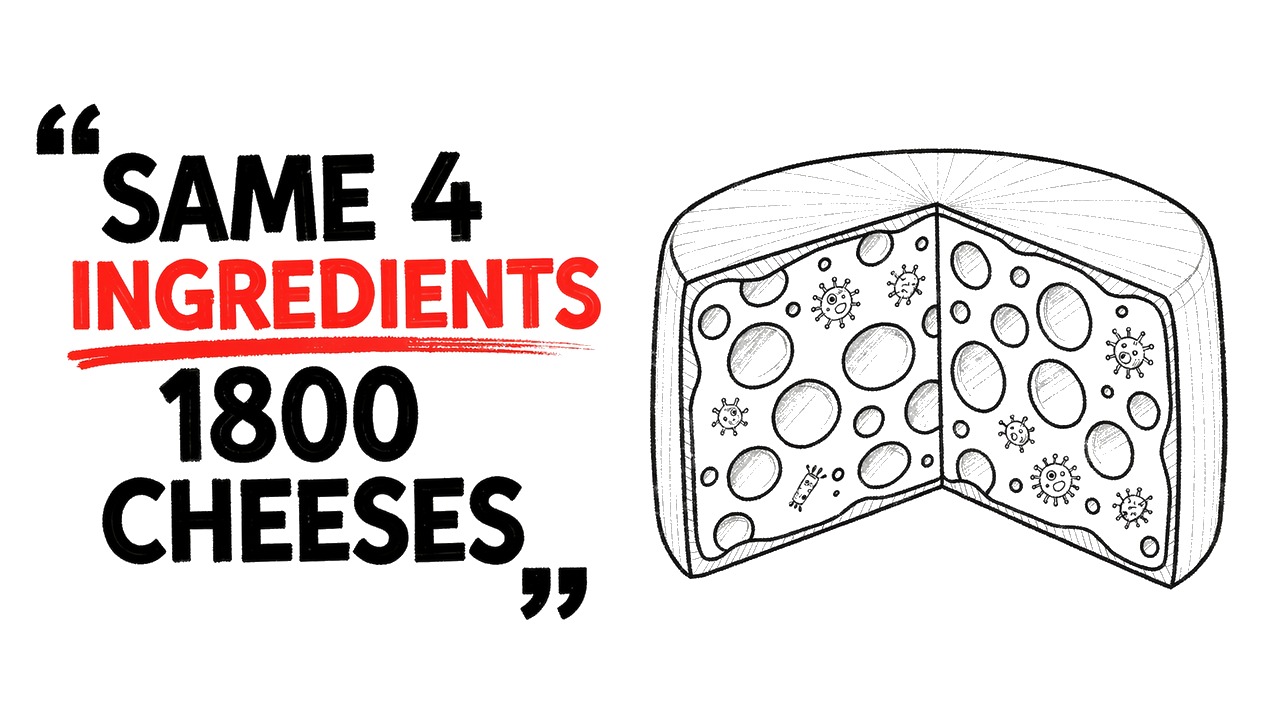
Crack open a wheel of aged Parmesan and you'll find hard, golden layers full of tiny white crystals and deep savory flavor. Set it next to a spoonful of soft, milky ricotta. They look and taste like completely different foods — yet both begin with the exact same four ingredients: milk, bacteria, an enzyme, and salt.
The basic process hasn't changed in at least 7,500 years. Bacteria sour the milk slightly, rennet causes the proteins to clump into a solid mass, and the watery whey drains away. What's left is the foundation of every cheese ever made. What's remarkable is how much variety humans have pulled out of those same four steps — over 1,800 named varieties and counting.
The differences come down to three forces: the animal the milk came from, the specific microbes introduced during making, and the amount of time allowed for chemistry to quietly unfold. Buffalo milk, goat milk, and sheep milk each carry different fat and protein structures before a single bacterium is added. And two blue cheeses made almost identically — Roquefort in a French cave, Gorgonzola in an Italian cellar — can taste nothing alike because of the specific microbial communities living in each place.
This video walks through the science behind that variety: why certain cheeses are legally tied to a single region, what those crunchy white crystals in aged Parmesan actually are, and why the whole universe of cheese is really just slow biology happening inside a wheel of milk.
by boldquartz411 · 2:08 ·